
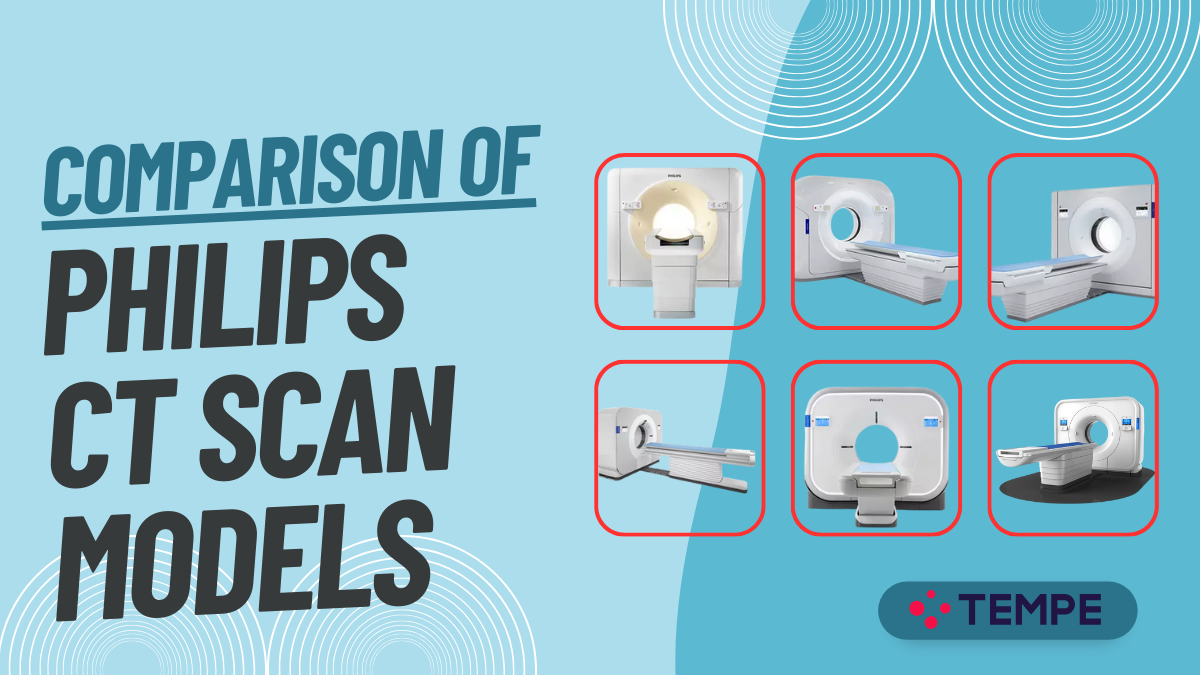
Philips has produced several generations of CT scanners, from widely installed Brilliance systems to the Ingenuity family and newer Incisive CT platforms. For a hospital, imaging center, or medical-equipment buyer, the model name alone is not enough to determine whether a system is the right fit. Clinical workload, configuration, site requirements, service history, tube condition, installed software, and long-term parts support can all affect the value of a CT scanner.
This guide compares the main Philips CT families at a practical buyer level. It focuses on verified model and configuration information and on the checks that matter when evaluating a used or refurbished Philips CT scanner. Exact specifications can vary by system configuration and software release, so the serial number and installed options should always be confirmed before purchase.
Philips CT Models at a Glance
The table below summarizes Philips CT families commonly encountered in equipment sourcing. It is intended as a starting point rather than a substitute for checking the exact configuration of an individual scanner.
| Model / Family | Verified Configuration Reference | Buyer Positioning | Important Notes |
|---|---|---|---|
| Brilliance CT 6 / 16 | Philips site-planning documentation identifies Brilliance CT 16/6-Slice systems. | Established multislice platforms for facilities evaluating earlier Philips CT generations. | Confirm the exact slice configuration, tube, software release, and site requirements on the specific unit. |
| Brilliance CT 64-channel | Philips identifies a Brilliance CT 64-channel platform. | Higher-configuration Brilliance system for routine and more advanced multislice CT applications. | Do not assume every Brilliance 64 has the same software, cardiac options, or reconstruction package. |
| Brilliance iCT / iCT family | Philips documentation identifies the iCT family separately from Brilliance 64 and Ingenuity. | Higher-end Brilliance-generation platform encountered in used CT sourcing. | Verify the exact iCT variant, acquisition configuration, software, tube history, and installed options. |
| Ingenuity Core | Philips documentation identifies Ingenuity Core within the Ingenuity CT family. | Upgradeable Ingenuity-family platform. | Verify the actual installed configuration rather than assuming an available upgrade has been performed. |
| Ingenuity Core128 | Philips identifies Core128 as a distinct Ingenuity-family configuration. | Higher configuration within the Ingenuity family. | Confirm that the offered system is actually configured as Core128 and document its installed software and options. |
| Incisive CT | Up to 128 slices, 40 mm coverage, 72 cm bore, 80 kW generator, and 8 MHU vMRC tube on Philips’ current product page. | Newer Philips CT platform focused on workflow and lifecycle efficiency. | Specifications and manufacturer programs can vary by market and configuration. |

Philips Brilliance CT Series
The Philips Brilliance name covers multiple CT generations and configurations, which is why buyers should avoid treating “Brilliance” as a single specification. Philips documentation includes Brilliance CT 16/6-Slice, Brilliance CT 64-channel, Brilliance Big Bore, and Brilliance iCT platforms. In the used-equipment market, the most important step is to identify the exact system, software release, and installed configuration rather than relying only on the family name.
Philips Brilliance 64
Philips identifies the Brilliance CT 64-channel as a 64-channel CT system. Philips continues to publish technical documentation and DICOM conformance information for the Brilliance 64 platform, which is useful when evaluating system generation, software compatibility, and integration requirements.
For a buyer, the practical question is not simply whether the scanner is described as “64 slice.” Confirm the installed software, reconstruction package, tube type and tube history, detector status, workstation configuration, optional clinical applications, and whether the system is being supplied complete with the components required for reinstallation.
Philips Brilliance iCT
Brilliance iCT is a higher-end platform from the Brilliance generation. Philips documentation identifies iCT and iCT-SP as separate CT platforms and continues to provide DICOM support documentation for the iCT family.
When evaluating an iCT on the secondary market, confirm the exact iCT variant and software release, detector and acquisition configuration, X-ray tube condition, reconstruction hardware, installed options, and deinstallation history. A seller’s use of a high reconstructed-slice count in a listing should not replace verification of the actual scanner configuration.
Philips Ingenuity CT Series
The Ingenuity family sits between earlier Brilliance platforms and newer Philips CT generations. Philips documentation identifies several members of the family, including Ingenuity Core, Ingenuity Core128, and Ingenuity CT. This distinction matters because the names can appear similar in used-equipment listings even though installed capabilities may differ.
A used-equipment buyer should verify the system label, serial number, exact model designation, software release, installed reconstruction technologies, and licensed clinical options. Tube usage and replacement history, detector condition, service records, and system completeness are also important because two scanners marketed under the Ingenuity name can represent materially different acquisition and ownership profiles.
Philips Incisive CT Series
Incisive CT is a newer Philips CT platform. Philips currently specifies the system with up to 128 slices, 40 mm coverage, a 72 cm bore, an 80 kW generator, and an 8 MHU vMRC tube. Philips also lists 70, 80, 100, 120, and 140 kV settings for the current configuration shown on its product page.
For buyers comparing Incisive CT with older Philips platforms, the main distinction is not just slice count. Incisive belongs to a newer workflow and service generation and includes patient-side gantry controls. Philips also markets a “Tube for Life” program for Incisive CT, but Philips states that availability varies by country. A buyer of a used or refurbished unit should not assume that this or any manufacturer commercial program is included or transferable unless it is confirmed for the specific system and market.
If a listing describes an Incisive CT as a 128-slice system, confirm the installed configuration from system records or manufacturer documentation. “Up to 128 slices” describes the product-family capability and does not by itself prove the configuration of an individual scanner.
Other Philips CT Platforms Buyers May Encounter
Philips IQon Spectral CT
Philips identifies IQon Spectral CT as a detector-based spectral CT platform. Philips’ current refurbished-equipment information describes IQon as the world’s first detector-based spectral CT system and emphasizes that spectral information is acquired as part of the scan rather than through a separate dual-energy workflow.
For a used IQon system, buyers should verify the exact software version, detector status, spectral-analysis environment, workstation configuration, service history, tube condition, and availability of qualified technical support for the installed generation.
Philips Spectral CT 7500
Spectral CT 7500 is a newer detector-based spectral CT platform. Philips describes it as providing conventional and spectral results from the same scan, with spectral information available without requiring a separate special acquisition protocol.
Because this is a different technology and product generation from older Brilliance and Ingenuity scanners, it should not be compared only by slice count. Clinical requirements, spectral workflow, software, service infrastructure, site requirements, and total acquisition cost are more meaningful comparison points.
How to Choose the Right Philips CT Scanner
A useful CT comparison starts with the clinical and operational requirement, then works backward to the system. Before choosing between Brilliance, iCT, Ingenuity, Incisive, or a spectral CT platform, review the following:
- Intended examinations and workload: Define whether the scanner will be used for routine CT, trauma, angiography, cardiac, oncology, emergency, or other specialized applications.
- Required configuration: Determine the acquisition and reconstruction capability actually needed instead of selecting a scanner only by the largest advertised slice count.
- Room and site constraints: Confirm gantry and table dimensions, equipment-room requirements, electrical service, cooling, shielding, and access for rigging and installation.
- X-ray tube and major-component status: Review tube usage information when available, replacement history, and any available test or service documentation.
- Detector and system status: Check detector condition, image-quality history, error logs, and service findings where available.
- Software and options: Verify software release, reconstruction technologies, specialty packages, DICOM functionality, and licensed applications included with the system.
- Service history: Request preventive-maintenance and repair records when available and identify recurring faults or major component replacements.
- Parts and service support: Consider the availability of qualified service, replacement parts, and technical support for the exact platform and software generation.
- Total project budget: Include deinstallation, crating, transport, rigging, site preparation, installation, calibration, acceptance testing, and future service costs.
What to Verify When Buying a Used or Refurbished Philips CT
Condition descriptions such as “used,” “pre-owned,” and “refurbished” do not by themselves define what has been tested or replaced. Before committing to a Philips CT scanner, request a system-specific record that covers as many of the following points as possible:
- Exact model, serial number, manufacturing year, and current configuration
- Confirmed channel/slice or acquisition configuration rather than a generic family description
- X-ray tube model, replacement history, and available tube-usage or performance information
- Detector status and any known detector, gantry, generator, table, or reconstruction-system issues
- Software version, licensed clinical options, and reconstruction packages included with the sale
- Console, workstation, monitors, injector interface, accessories, manuals, and other components included
- Service and preventive-maintenance records, including major repairs or component replacements when available
- Deinstallation status: still installed and operational, professionally deinstalled, or already stored
- Site-planning and installation requirements for the destination facility
- Packing, crating, transport, and rigging responsibilities
- Current equipment condition, availability, scope of testing, and any seller warranty stated in the actual quotation
For higher-value CT acquisitions, the final purchase decision should be based on serial-number-level configuration and available service documentation rather than the model name alone.
Philips CT Parts, Service, and Sourcing Through TEMPE
Technomed Medical Parts and Equipment (TEMPE) can assist buyers with sourcing Philips CT equipment and replacement parts based on current availability. Visit the Philips manufacturer page to review Philips equipment and parts currently listed by TEMPE.
For Brilliance systems, TEMPE’s catalog may also include system-specific components such as the Philips Brilliance DMS 16 Slice Assembly, Philips CT Brilliance 5V Power Supply, Philips Brilliance GHOST BASEBD Assembly, and Philips Brilliance CGMP Assembly. Compatibility should always be confirmed using the exact scanner model, configuration, and part number before ordering.
Frequently Asked Questions
What Philips CT scanner models are available?
Philips has produced multiple CT families, including Brilliance, Brilliance iCT, Ingenuity, IQon Spectral CT, Spectral CT 7500, and Incisive-generation systems. In the used-equipment market, availability changes continuously, so buyers should identify their clinical requirement first and then confirm the exact model and configuration currently available.
What is the difference between Philips Brilliance and Ingenuity CT?
Brilliance covers an earlier, broad range of Philips CT platforms, including Brilliance 16/6-Slice, Brilliance 64-channel, and Brilliance iCT. Ingenuity is a later family that includes configurations such as Ingenuity Core and Core128. The practical differences depend on the exact scanner, software, tube, detector configuration, and installed options.
What are the Philips Incisive CT specifications?
Philips currently lists Incisive CT with up to 128 slices, 40 mm coverage, a 72 cm bore, an 80 kW generator, and an 8 MHU vMRC tube. Exact specifications and available options can vary by configuration and market.
Is Philips Brilliance 64 a 64-slice CT scanner?
Philips documentation identifies the system as Brilliance CT 64-channel. When purchasing a used system, confirm the exact acquisition configuration, software release, and installed options instead of relying only on a marketplace description.
Is Philips iCT a 256-slice scanner?
Philips literature for the Brilliance iCT generation has used reconstructed-slice descriptions of up to 256 slices. Because “slice count” can be used differently for detector rows, acquisition channels, and reconstructed images, buyers should verify the exact detector and acquisition configuration of the specific scanner being offered.
How should I select a used Philips CT scanner?
Start with the examinations and daily workload you need to support. Then verify the exact scanner configuration, tube and detector condition, software and licenses, service history, site requirements, included components, installation plan, and long-term parts and service support. These factors are usually more useful than comparing model names alone.
Request Current Availability or a Quote
If you are sourcing a Philips CT scanner, contact Technomed Medical Parts and Equipment (TEMPE) with the model or configuration you need, your intended application, and the destination country. TEMPE can check current equipment or parts availability and help identify the information that should be verified before a quotation or purchase decision.